
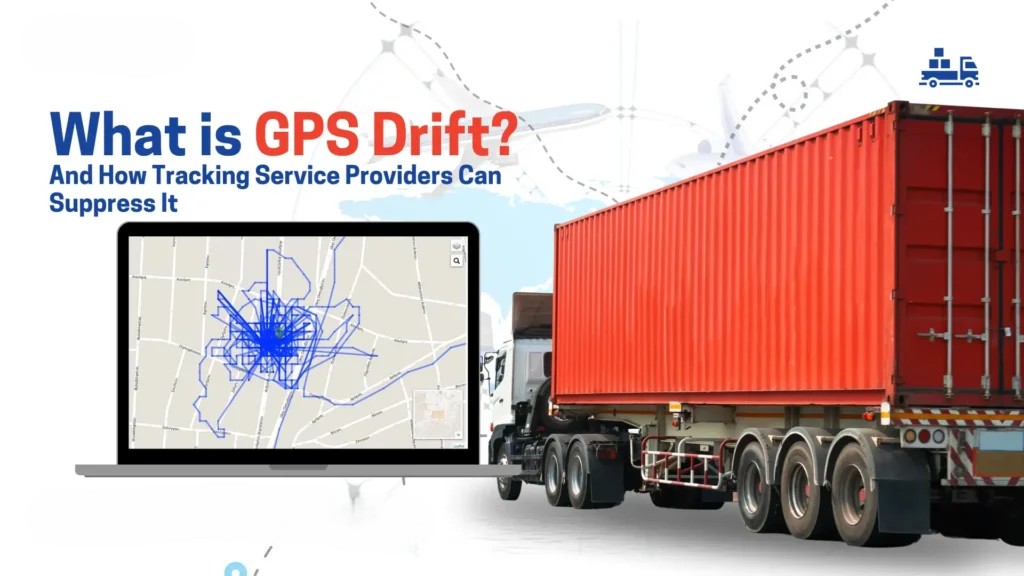
What is GPS Drift? And How Tracking Service Providers Can Suppress It

In vehicle and asset tracking, data accuracy is crucial. Customers rely on real-time positioning data to track their fleet, make decisions around safety, billing, and compliance. Yet, one of the most common and often misunderstood issues with GPS-based systems is GPS Drift.

If you’ve ever seen a vehicle “jump” across the map while parked or appear slightly off its actual route, you’ve experienced GPS drift firsthand. While small inaccuracies may seem harmless, at scale they can be frustrating, generate false alerts, and undermine trust in your tracking service.

In this article we’ll explains what GPS drift is, why it happens, and most importantly, what you can do to suppress and manage it.

What is GPS Drift?

GPS Drift refers to small, unintended changes in a reported GPS location that cause a stationary or moving asset to appear slightly off its true position. In other words, the system “thinks” the asset has moved when, in reality, it has not, or it places the vehicle on a parallel road or outside its actual route.

For example:

These issues stem from inherent limitations in GPS technology, not necessarily from faulty software.

What Causes GPS Drift?

Understanding the causes helps in designing solutions. Common contributors include:

  1. Poor Installation Areas. Devices installed in poor locations, such as under the dashboard, near metal surfaces, or behind tinted glass with metallic coatings are more prone to drift. A clear sky view drastically improves accuracy(most devices indicate which side should be facing up).
  2. Satellite Geometry. GPS receivers need signals from at least four satellites to calculate a position. When satellites are clustered close together in the sky (poor geometry), positional accuracy decreases.
  3. Signal Reflection (Multipath Error). In dense urban areas, signals bounce off tall buildings, causing the receiver to calculate an inaccurate position. The same effect can happen in mountainous or heavily forested terrain.
  4. Atmospheric Conditions. The ionosphere and troposphere can slightly bend or delay GPS signals, leading to small positional errors.
  5. Receiver Quality. Low-quality or outdated GPS chips may struggle with sensitivity and error correction, leading to greater drift compared to professional-grade modules.
  6. Environmental Factors. Tunnels, bridges, and indoor parking lots can weaken or block signals entirely, forcing the device to “guess” positions until reception improves.

Why Does GPS Drift Matter for Tracking Service Providers?

For end users, drift can quickly erode trust in the system. Problems include:

In competitive markets, consistent accuracy is a differentiator. Providers who can minimize drift enjoy higher customer retention and fewer support tickets.

How Can Tracking Service Providers Suppress GPS Drift?

Understanding the causes helps in designing solutions. Common contributors include:

  1. Quality GPS Modules. Support for multiple constellations (GLONASS + Galileo + BeiDou) in addition to GPS, a receiver can ”see” many more satellites globally. This will translate to stronger fixes, less error, faster time-to-fix and stronger resilience against multipath errors.
  2. Enabling Assisted-GPS (A-GPS). Normally, a GNSS receiver determines its position by downloading from satellites; essentially, where each satellite is and how it’s moving. That process can take up to 30–60 seconds (sometimes longer in poor conditions)A-GPS shortens this process by providing satellite orbital data through a mobile network (cellular, Wi-Fi, or IP connection) instead of waiting for it to arrive via satellite. So instead of “listening” to the sky for half a minute, the device gets the data instantly over 2G/3G/4G and locks onto satellites much faster.
  3.  Smart Firmware Filters. Many modern tracking devices come with built-in filters that ignore “impossible” movements. For example: If a vehicle is stationary but the GPS position suddenly shifts 30 meters, the device can discard the false movement. Speed thresholds can be set to reject unrealistic jumps (e.g., a car “moving” 300 km/h while parked).
  4. Accelerometer Integration. Devices equipped with accelerometers can cross-check GPS data. If the accelerometer detects no movement but the GPS shows a shift, the system can conclude that the drift is false.
  5. Geofence Tolerance Settings. Rather than setting razor-thin geofence boundaries, you can allow a small buffer zone. This helps avoid unnecessary alerts caused by minor drift around the fence edges.
  6. Device Placement Best Practices. Training installers is critical. Devices mounted in poor locations (under the dashboard, near metal surfaces, or behind tinted glass with metallic coatings) are more prone to drift. A clear sky view drastically improves accuracy(most devices indicate which side should be facing up).
  7. Regular Firmware and Platform Updates. Device manufacturers frequently improve algorithms for drift suppression. Ensuring that your fleet of devices runs the latest firmware.

The Business Case for Suppressing Drift

For tracking service providers, suppressing drift isn’t just about technical accuracy, it’s about customer confidence and operational efficiency. Benefits include:

In short, effective drift suppression builds trust and trust keeps customers loyal.

Final Thoughts

GPS drift is a natural side effect of satellite navigation technology. But for tracking service providers, allowing it to go unchecked can damage customer relationships and brand credibility.

By combining quality hardware and proper installation practices, you can greatly reduce drift and deliver a smoother, more accurate tracking experience.

In the event you experience GPS Drift, consult with your manufacturer if your hardware supports a setting to supress GPS drift.


  Let's talk

Telephone

1 888 220 8833

Email Address

hello@fleettracker.ca